
What to recite in salah: what to say in each position
From the opening takbir to the final salam, with the source of each dhikr
You enter the prayer with the takbir. Standing, you recite Al-Fatiha, then a surah in the first two rak‘ahs. Bowing and then prostrating, you glorify Allah; rising upright, you praise Him. Sitting, you recite the tashahhud, and the prayer ends with the final salam.
What every school does
The four schools describe the same positions, in the same order. The takbir marks each move from one position to the next, and Al-Fatiha has its place in every rak‘ah.
The words of some dhikr vary slightly from one school to another: those on this page come from the app’s library, with their source.
The Prophet ﷺ said the takbir when starting the prayer, then each time he bowed, prostrated or rose; when straightening up from bowing, he said that Allah hears whoever praises Him, then praised Him.
The Prophet ﷺ said that there is no prayer for the one who does not recite Al-Fatiha.
The positions, one by one
For each position: what you do, then what you say. The text of a dhikr is given only with its source and grade; otherwise, its meaning is given.
-
The opening takbirtakbirat al-ihram
Standing, you raise your hands and say the takbir: you enter the prayer, and from then on you speak only for it.
What it means
Declaring that Allah is greater than everything. The takbir then comes back at each change of position.
-
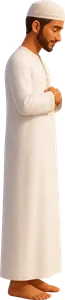
Standing: Al-Fatihaal-qiyam
Standing calmly, you recite Al-Fatiha in every rak‘ah, then a surah or a few verses in the first two.
-
بِسْمِ ٱللَّهِ ٱلرَّحْمَـٰنِ ٱلرَّحِيمِ
bismi llāhi r-raḥmāni r-raḥīm
In the name of Allāh, the Entirely Merciful, the Especially Merciful.
-
ٱلْحَمْدُ لِلَّهِ رَبِّ ٱلْعَـٰلَمِينَ
al-ḥamdu lillāhi rabbi l-ʿālamīn
[All] praise is [due] to Allāh, Lord of the worlds -
-
ٱلرَّحْمَـٰنِ ٱلرَّحِيمِ
ar-raḥmāni r-raḥīm
The Entirely Merciful, the Especially Merciful,
-
مَـٰلِكِ يَوْمِ ٱلدِّينِ
māliki yawmi d-dīn
Sovereign of the Day of Recompense.
-
إِيَّاكَ نَعْبُدُ وَإِيَّاكَ نَسْتَعِينُ
iyyāka naʿbudu wa'iyyāka nastaʿīn
It is You we worship and You we ask for help.
-
ٱهْدِنَا ٱلصِّرَٰطَ ٱلْمُسْتَقِيمَ
ihdina ṣ-ṣirāṭa l-mustaqīm
Guide us to the straight path -
-
صِرَٰطَ ٱلَّذِينَ أَنْعَمْتَ عَلَيْهِمْ غَيْرِ ٱلْمَغْضُوبِ عَلَيْهِمْ وَلَا ٱلضَّآلِّينَ
ṣirāṭa lladhīna 'anʿamta ʿalayhim ghayri l-maghḍūbi ʿalayhim wala ḍ-ḍāllīn
The path of those upon whom You have bestowed favor, not of those who have earned [Your] anger or of those who are astray.
-
-
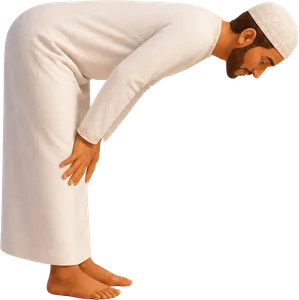
Bowingar-ruku‘
You say the takbir and bow, back straight, hands on the knees, long enough to be at rest.
What it means
You glorify Allah, calling Him the Most Great: this is the tasbih of bowing, said at least once, often three times.
-
Rising from bowingat-tasmi‘
You rise from bowing until you are fully upright.
What it means
You say that Allah hears whoever praises Him. The imam, and whoever prays without an imam, say it while rising.
-
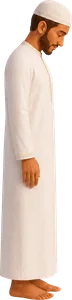
Standing: the praiseat-tahmid
Once fully upright, you praise Allah, then go down into prostration.
What is said
رَبَّنَا وَلَكَ الْحَمْدُ، حَمْداً كَثيراً طَيِّباً مُبارَكاً فِيهِ
Rabbanâ wa laka l-hamd, hamdan kathîran tayyiban mubârakan fîh
Our Lord, to You belongs all praise: an abundant, good and blessed praise.
Sahih al-Bukhari 799 · grade: sahih (authentic), graded by al-Bukhari -
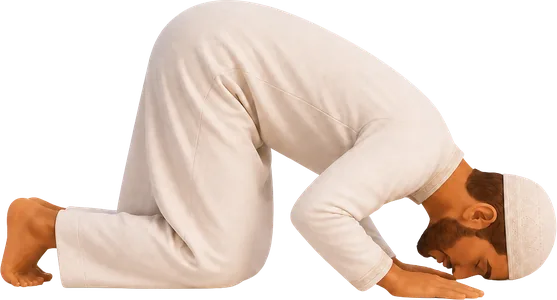
Prostrationas-sujud
You say the takbir and prostrate: forehead and nose, both hands, the knees and the toes touch the ground.
What it means
You glorify Allah, calling Him the Most High: this is the tasbih of prostration, said at least once, often three times.
-
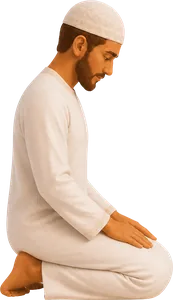
Sitting between the two prostrationsal-julus
You rise saying the takbir, sit for a calm moment, then prostrate a second time in the same way.
What is said
رَبِّ اغْفِرْ لِي، رَبِّ اغْفِرْ لِي
Rabbi-ghfir lî, Rabbi-ghfir lî
My Lord, forgive me. My Lord, forgive me.
Sunan Ibn Majah 897 · grade: sahih (authentic), graded by al-Albani -
The tashahhudat-tashahhud
After the second rak‘ah, and at the end of the prayer, you sit for the tashahhud. In a prayer of 3 or 4 rak‘ahs, you then stand up for the rest.

What is said
التَّحِيَّاتُ لِلَّهِ، وَالصَّلَواتُ، وَالطَّيِّباتُ، السَّلاَمُ عَلَيْكَ أَيُّهَا النَّبِيُّ وَرَحْمَةُ اللَّهِ وَبَرَكَاتُهُ، السَّلاَمُ عَلَيْنَا وَعَلَى عِبَادِ اللَّهِ الصَّالِحِينَ. أَشْهَدُ أَنْ لاَ إِلَهَ إِلاَّ اللَّهُ وَأَشْهَدُ أَنَّ مُحَمَّداً عَبْدُهُ وَرَسولُهُ
At-tahiyyâtu lillâhi, wa s-salawâtu, wa t-tayyibât, as-salâmu 'alayka ayyuhâ n-nabiyyu wa rahmatu Llâhi wa barakâtuh, as-salâmu 'alaynâ wa 'alâ 'ibâdi Llâhi s-sâlihîn. Ash-hadu an lâ ilâha illâ Llâhu wa ash-hadu anna Muhammadan 'abduhu wa rasûluh
All greetings, prayers and good deeds belong to Allah. Peace be upon you, O Prophet, and the mercy of Allah and His blessings. Peace be upon us and upon the righteous servants of Allah. I bear witness that there is no god worthy of worship but Allah, and I bear witness that Muhammad is His servant and His Messenger.
Sahih al-Bukhari 1202 · grade: sahih (authentic), graded by al-Bukhari -
Prayers upon the Prophet ﷺas-salat al-ibrahimiyya
In the last sitting, after the tashahhud, you send prayers upon the Prophet ﷺ.
What is said
اللَّهُمَّ صَلِّ عَلَى مُحَمَّدٍ، وَعَلَى آلِ مُحَمَّدٍ، كَمَا صَلَّيتَ عَلَى إِبْرَاهِيمَ، وَعَلَى آلِ إِبْرَاهِيمَ، إِنَّكَ حَمِيدٌ مَجِيدٌ، اللَّهُمَّ بَارِكْ عَلَى مُحَمَّدٍ وَعَلَى آلِ مُحَمَّدٍ، كَمَا بَارَكْتَ عَلَى إِبْرَاهِيمَ وَعَلَى آلِ إِبْرَاهِيمَ، إِنَّكَ حَمِيدٌ مَجِيدٌ
Allâhumma salli 'alâ Muhammadin, wa 'alâ âli Muhammadin, kamâ sallayta 'alâ Ibrâhîma, wa 'alâ âli Ibrâhîm, innaka hamîdun majîd, Allâhumma bârik 'alâ Muhammadin wa 'alâ âli Muhammadin, kamâ bârakta 'alâ Ibrâhîma wa 'alâ âli Ibrâhîm, innaka hamîdun majîd
O Allah, send prayers upon Muhammad and upon the family of Muhammad, as You sent prayers upon Ibrahim and upon the family of Ibrahim. You are worthy of praise and glory. O Allah, bless Muhammad and the family of Muhammad, as You blessed Ibrahim and the family of Ibrahim. You are worthy of praise and glory.
Sahih al-Bukhari 3370 · grade: sahih (authentic), graded by al-Bukhari -
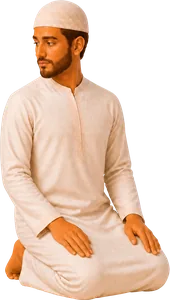
The final salamat-taslim
You end the prayer by turning your head to the right, then, for most schools, to the left.
What it means
With each salam, you wish peace and the mercy of Allah.
To a man who prayed too quickly, the Prophet ﷺ taught him to take the time to be at rest in each position: bowing, upright again, prostrating and sitting.
‘Ikrima counted twenty-two takbirs behind an imam in Makkah; Ibn ‘Abbas told him that this was the Sunnah of the Prophet ﷺ.
The four schools, all valid
Which surah after Al-Fatiha?
In the first two rak‘ahs, you recite a surah or a few verses after Al-Fatiha. To begin with, a short surah is enough.
Frequently asked questions
How many times is the tasbih of bowing said?
At least once, and many repeat it three times. Your imam can tell you what your community follows.
Should the hands be raised at every takbir?
All the schools raise the hands at the opening takbir. For the others they differ: the Shafi‘is and Hanbalis also raise them around the bowing, the Hanafis and Malikis only at the opening.
I don’t know the tashahhud yet: what should I do?
Learn it little by little, by listening and repeating. In the meantime, ask your imam what suits your situation.
How can I check my Fatiha and the surahs I recite in prayer?
Recite them out loud in the Tilawa app: it follows your recitation word by word and shows you the words and tajweed rules to work on. During prayer, it can also follow the verses you recite.
Tilawa editorial team · Updated 2026-10-24 · Report an error